Tushar Gandhi
April 15, 2026
I write this on April 14, the birth anniversary of the architect of our Constitution, Dr Bhimrao Ambedkar, affectionately called ‘Babasaheb’. This year marks two important anniversaries – the start of the bicentennial year of Mahatma Jyotiba Phule on April 11 and the beginning of the 100th year of the epic Mahad Satyagraha led by Babasaheb. He defied the upper-caste-enforced prohibition of untouchables taking water from natural and manmade sources.
On March 20, 1926, Babasaheb, along with thousands of his Dalit followers, gathered on the banks of the Chavdar Tale, a manmade lake in Mahad in Maharashtra. He drank water from the tank in defiance of the exclusion.
Mahatma Phule strove all his life for samata, equality and dignity for all in Hindu society, and along with his wife, Savitri, worked tirelessly for girls’ education. The couple was ostracised, abused and assaulted by upper castes, but they carried on tirelessly.
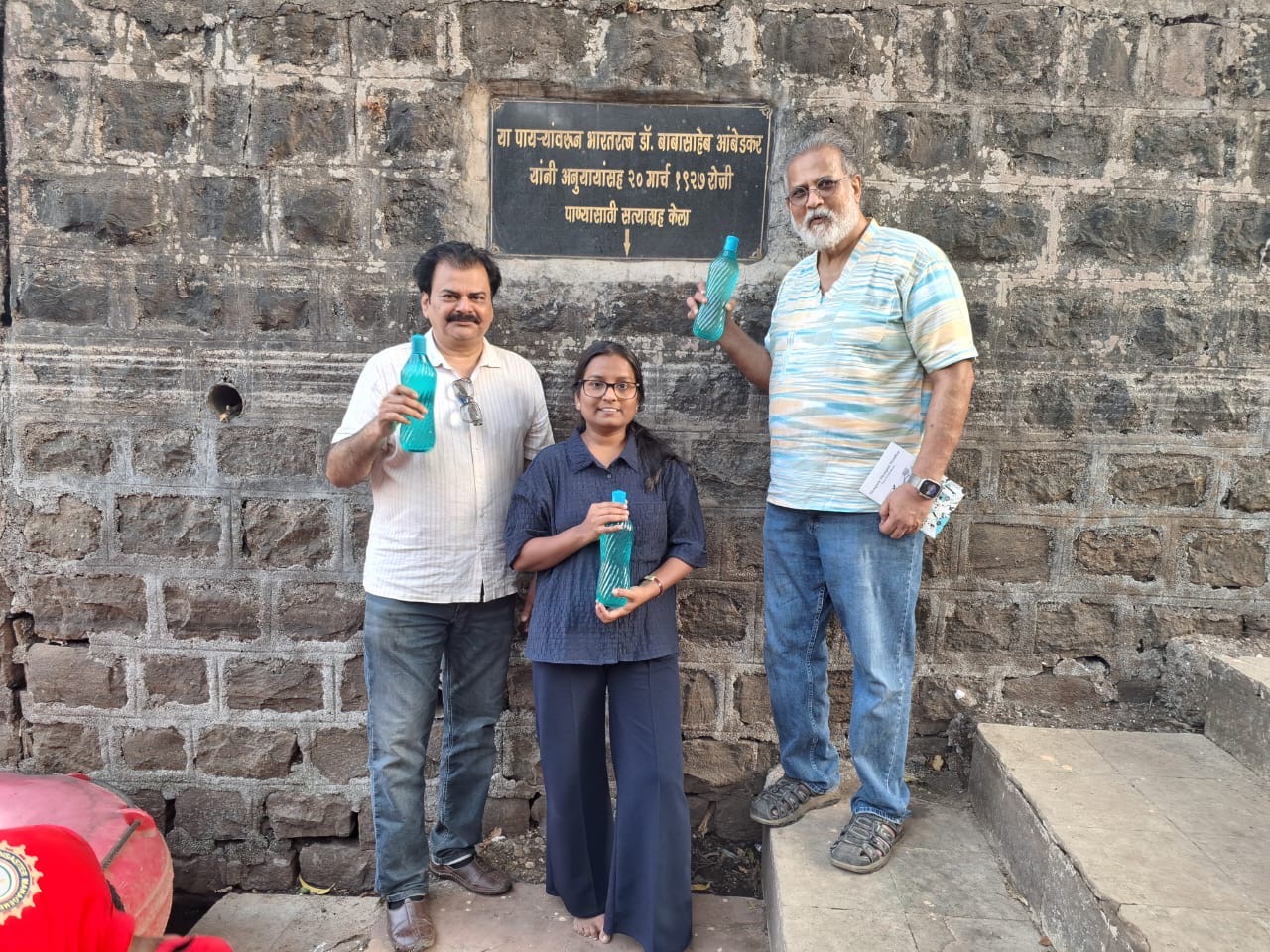
Tushar Gandhi (extreme right) at Chavdar Tale.
On March 19, I visited Mahad to commemorate the anniversary of the satyagraha. The CPI(M) held a meeting, which we attended. There was a march from Raigad to Mahad, ending at the ground where the year after the satyagraha Babsaheb burnt the Manusmriti. We joined the last leg of the march from the statue of Chhatrapati Shivaji Maharaj till the ground consecrated by the Manusmriti’s ashes. Then we collected water from Chavdar Tale. Hum Bharat Ke Log, an organisation promoting Gandhian values, decided to carry the water blessed by Babasaheb to Mumbai and pour it into the Banganga Tank in Walkeshwar. We did so on March 27. We plan to take Chavdar Tale water and pour it into ‘holy’ water sources across India as a symbolic gesture of samata.
Worrying events at Mumbai University
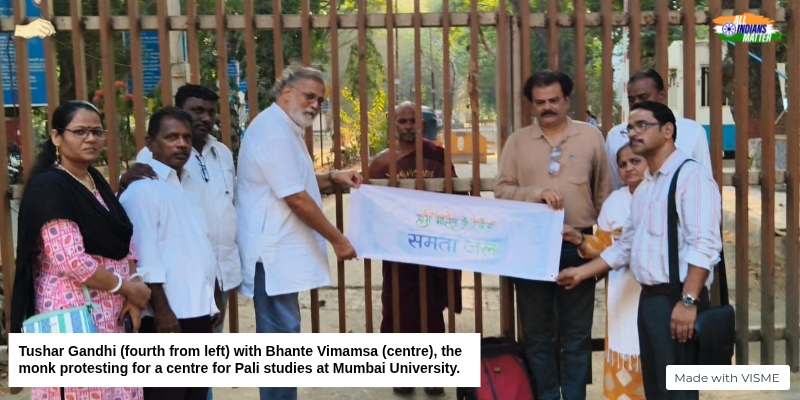
Later, I was taken to Vidyanagari, Mumbai University’s Kalina campus. I was told that a Buddhist monk, Bhante Vimamsa, was sitting on satyagraha there demanding a centre for the study of the ancient Pali language. Pali was one of the premier ancient languages of India, originating from the Prakrit group of languages. Buddhism in India communicated using Pali, and it is one of the ancient languages of Maharashtra too. Now, because it is associated with Buddhism, it is erroneously treated as Ambedkarite and discriminated against.
The demand for a Pali Bhavan, a centre for research and conservation of the language and its literature has been long standing. The University Grants Commission (UGC) had given a grant for it but Mumbai University decided that Pali did not deserve such a centre despite the fact that more than 400 students enrolled to study it. There are also post-graduates in its study and those completing their PhDs. Despite this, the university clubbed it with other ancient languages and created a unified centre for their study. This centre too is incomplete and the Department of Pali is forced to function from an inadequate space.
There is a legitimate demand for a hostel for students of the Pali department, which too has been denied. There is no clarity on why the university and the Central Government, under whom the UGC functions, is behaving in this manner.
The university, meanwhile, rusticated Bhante Vimamsa, a PhD scholar there.
Is the university established to provide education to seekers and students or to fight battles with students demanding better facilities?
A monk’s struggle
Bhante Vimamsa used to be Rajesh Balkhande, who was conducting research on Pali. He decided to become a Buddhist monk and enrolled in a monastery in Myanmar to study scriptures and receive diksha. After that, he took the name Bhante Vimamsa.
For the diksha, he had taken a sabbatical. On his return, he resumed his studies and raised the demand for a Pali Bhavan. Bhante Vimamsa tried to meet Union minister Kiren Rijiju when he visited Vidyanagari but was assaulted by guards and had to be admitted to the ICU. He was also humiliated by having his robes ripped off. The police have not filed an FIR in this case so far. The university, meanwhile, rusticated him along with 600 other ‘truant’ students.
The demands for a Pali Bhavan and an adequate hostel are legitimate. Isn’t this what universities are supposed to do? Are we not a democracy? Aren’t summarily rusticated students entitled to an appeal and legal recourse? Isn’t Bhante Vimamsa entitled to his rights as a citizen of India?
When I reached Vidyanagari, the policemen at the gate asked me the reason for my visit. I introduced myself and said I wished to meet Bhante Vimamsa. They politely but firmly made it clear that I would not be allowed in, “hukuma varoon.” (As per orders.) I asked whose and, after much hesitation, they said: “Prashasanacha.” (The administration’s.) It wasn’t clear whether they meant the state administration or the university’s.
They stopped me from peacefully entering a public institution to meet a monk who was offering non-violent satyagraha. I was eventually able to speak to him briefly through a gate. The administration seems to be afraid of peaceful satyagraha at a time when there are mobs entering campuses and ransacking them. Jawaharlal Nehru University and Jamia Milia are two examples.
The university seems to be behaving in a discriminatory manner. I heard that a few days earlier a lecture by actor Naseeruddin Shah was cancelled at the last minute, after being invited by the university’s Urdu Department. Activist and filmmaker Anand Patwardhan was also stopped from meeting Bhante Vimamsa. The university’s objective is to isolate the monk and break his resolve. He has been denied access to his room and a bathroom. He has been on satyagraha in the open for two months without being able to even change his robes, shave or bathe. This is inhuman. Such behaviour by a university whose alumni includes Babasaheb is shameful.
Bhante Vimamsa is receiving such treatment in Mumbai, where the Quit India Movement was born; which was the residence of Babasaheb; the birthplace of the Dalit Panthers; where lies the holiest of holy shrines, Chaitya Bhoomi, where Babasaheb was cremated. Mumbai is the cosmopolitan, liberal capital of India. Yet, Bhante Vimamsa struggles alone. The city and society in general aren’t bothered.
The unfolding of events reminds me of the Rohith Vemula case. Vemula, a PhD scholar at the University of Hyderabad, committed suicide due to systemic caste discrimination.
In this, the 100th year of the historic Mahad Satyagraha, in this the bicentennial year of Mahatma Jyotiba Phule, have we abandoned samata? It’s a hard question we need to answer.
Bhante Vimamsa is just one case. There are so many Dalits who are discriminated against, assaulted and lynched in India. When will Amrit Kaal dawn for them? Will it ever?
Tushar Gandhi, great grandson of the Mahatma, is an activist, author and president of the Mahatma Gandhi Foundation. Reach him here: gandhitushar.a@gmail.com.