This is the concluding part of the series that sheds light on what happened in the run-up to Mahatma Gandhi’s assassination, the immediate aftermath of it and the days that followed.
Tushar Gandhi
January 31, 2026
There are a few recorded accounts of those who witnessed the murder. Some of them are in the FIR of the murder recorded at the Tughlaq Road Police Station. Others were recorded during the trial conducted at the Red Fort.
I reproduce an account of how Gandhi’s associates heard about Bapu’s murder. It was recorded in the memoir of Kamlaben Patel, a Gandhian assigned the task of recovering and repatriating women and children from both sides of the new border in Punjab. Kamlaben worked from 1947 till 1950 in Lahore, Amritsar, Jallandhar, Karachi and Kashmir, recovering and repatriating hundreds of women and children and uniting them with their families on both sides of the Partition line.
She was in Amritsar along with Mridulaben Sarabhai, head of the Recovery Mission, on January 30, 1948, the day of the murder. She recorded the events of that day and the next in the memoir of her work, ‘Mool Sotta Ukhdela’.
I have completed its English translation and hope to soon publish it as ‘Angels of Partition’.
Kamlaben’s account, in her words
It was decided that a week-long programme would be held to hail the recovery of abducted women in February 1948. To prepare for this, a meeting was called of police officials from the districts of Indian East Punjab in the last week of January in Amritsar. I had come there from Lahore to participate in the meeting.
We were all tense; an unsuccessful attempt had been made on Bapu’s life on January 20. We were particularly concerned because a Punjabi refugee had been held for exploding a bomb at Bapuji’s prayer meeting; there was talk of his accomplices escaping.
Many attempts had been made on Bapu’s life previously. In the last two years, fanatic organisations had fanned anger against Bapu in a concerted manner.
Coincidentally, Prime Minister Pandit Jawaharlal Nehru was to visit Amritsar on January 30. He was to inspect an honour guard of the army at Gobindgarh Fort on the southern edge of Amritsar. The fort was popularly known as Bhangian da Quilla, the fort of the untouchables. It was built by Gujar Singh Bhangi in the 18th century. Maharaja Ranjit Singh renamed the fort after the 10th Sikh Guru, Guru Gobind Singhji. It is presently occupied by the Indian Army.
I accompanied Mridulaben early in the morning to welcome Pandit Nehru at the aerodrome. We then accompanied him to the ceremony at the fort. I was witnessing a very grand military parade, full of pomp, for the first time in my life. It was very impressive. The atmosphere was celebratory and joyous.
Panditji returned to Delhi after the parade. We accompanied him to the aerodrome. In the car, he told Mridulaben, “Mridul, Bapu’s life is in danger. I am very worried since the attempt on his life on 20th, but he refuses to accept more security. We can’t afford to lose Bapu at this juncture. Please convince him to accept more security; he might listen to you.”
After bidding farewell to Panditji, we returned to the meeting. The deliberations from the previous day continued. Everyone felt that we would make good progress in the task of recovery during ‘Recovery Week’ and it would speed up our work.
Mridulaben had organised a lunch for attending civil and police officials. She and I were to return to Lahore later in the afternoon. To cope with winter, we had dispatched woollens and blankets for our use to Lahore in a military truck earlier.
Before leaving, Mridulaben remembered that senior Congress leader Dr Saifuddin Kichlu had requested that his Mall Road residence in Amritsar, which was being used as an office by the relief work task forces, be returned to him. Mridulaben requested me to book a call to Dr Kichlu in Delhi. “I will speak to him before we leave for Lahore.” I booked the call. It took time to connect. I waited impatiently next to the phone all the while. Finally, the phone rang at 5.25 pm. I answered on the very first ring. The operator informed me that she was connecting me to Dr Kichlu. “Hello, Dr Kichlu, Mridulaben wishes to speak…” Dr Kichlu cut me off, sounding very agitated. “Kamla, Bapu has been shot. He is no more!” The receiver fell out of my hand.
I was stunned. I did not know what to do and how to react. My world had gone dark. I wasn’t given to crying easily but my cheeks were wet with tears. I rushed into the room where Mridulaben was resting. “Bapu has been shot. He is no more!” I gasped. I barely managed to say this before breaking down and weeping uncontrollably. Mridulaben was stunned and after a few seconds she turned on the radio. The Ram Dhun was being relayed from all stations, but there was no announcement. We called a few contacts in Delhi but did not get much coherent information; everyone was in deep shock.
News of Bapu’s murder spread like wild fire throughout Amritsar. People started flocking to the Amritsar Hotel. There were many rumours floating around, some spontaneous, others spread with malicious intent. It was being whispered that Muslims had murdered Bapu; there was talk of retaliation. We were all concerned that if this dastardly deed had been done by a Punjabi refugee and God forbid a Muslim, then the barely quietened rioting in Punjab would once again erupt. This time there would be no one who could stop the insanity. “What will we do now?” was what everyone was thinking. It was still difficult to believe that Bapu was no more.
The news was broken in the 6 pm news bulletin of All India Radio. It was announced that a Hindu Brahmin had shot Bapu. We were relieved. The country was plunged into grief.
We cancelled our plan to go to Lahore. Mridulaben and I left for Delhi; it was 10 pm by the time we started. We had sent off our woollens to Lahore, so we had nothing to protect us from the fierce winter of the Punjab. But the news of Bapu’s death had numbed us and we became unmindful of the biting cold. We could not even nap during the entire journey to Delhi.
I had spent a few of my growing up years at Sabarmati Ashram in the care of Ba (Kasturba) and Bapu. Memories of my life with them kept flashing through my mind. We rode in silence. Mridulaben tightly clasping my hand, I would sob occasionally and tears would flow from her eyes too. We drove directly to Birla House.
Birla House was besieged by grieving humanity. With great difficulty, we made our way inside and finally reached the room where Bapu’s body was lying in state. A continuous chanting of the Ram Dhun and recital of shlokas from the Gita were taking place. We saw family members, leaders, colleagues and acquaintances sitting, benumbed by grief, around Bapu.
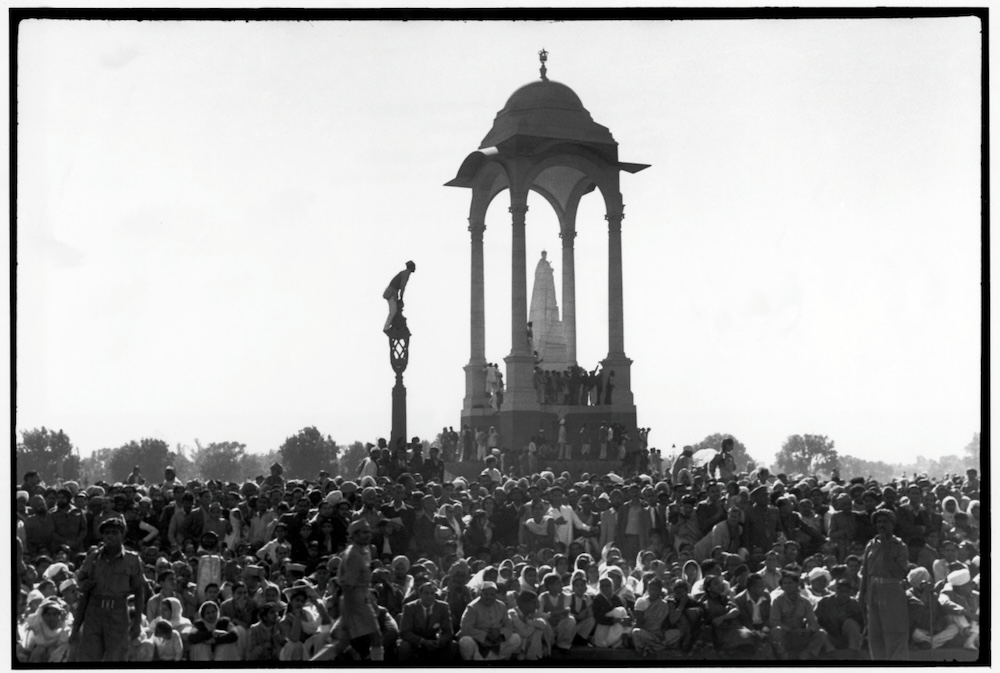
One of Henri Cartier-Bresson’s pictures of Mahatma Gandhi’s funeral.
The final journey of the liberator of India, my Bapu, began at the appointed hour. All of us accompanied the cortège on foot, silent and grief-stricken. Our grief had benumbed us to hunger, thirst and the fatigue of our bodies. To all of us, Gandhijan, the walk from Birla House to the cremation spot by the Yamuna meant only one thing: recollecting the moments we had spent with Bapu and trying to imagine life without him. I had once again lost a father.
After losing my mother, I, along with my sisters had lived in Sabarmati Ashram. Ba and Bapu had played a significant role in our growing up years. For me, they were parents. Ba passed away while imprisoned in the Aga Khan Palace and now Bapu was gone too. I was orphaned once again.
The entire route from Birla House to the cremation ground was one vast sea of grieving humanity. No one budged from the funeral grounds till the flames completely consumed Bapu. We sat there late into the night till the pyre was reduced to ashes.
After spending one more day in Delhi, I boarded a flight to Lahore. I was accompanied by many Muslim leaders of undivided Punjab. At the time of Partition, they had opted for Pakistan but for them too Bapu was undeniable. Forgetting their differences, they had come to Delhi to pay their respects.
There was a pall of gloom on board that day. I could sense that the Muslim leaders were grieving the loss of a true and dear friend and well-wisher. The grief on their faces was testimony to their respect for Bapu and the tremendous loss they too felt.
In a small way, I felt relief amidst the overwhelming grief. Bapu’s killer was a Hindu Brahmin from Poona, not a Punjabi refugee or a Muslim. Punjab and the country had been spared more savagery.
The memory of Bapu’s death brings to my mind the homage to him by the great English playwright, George Barnard Shaw: “It shows how dangerous it is to be good.”
Tushar Gandhi, great grandson of the Mahatma, is an activist, author and president of the Mahatma Gandhi Foundation. Reach him here: me@tushargandhi.in.