Ashraf Engineer
July 28, 2026
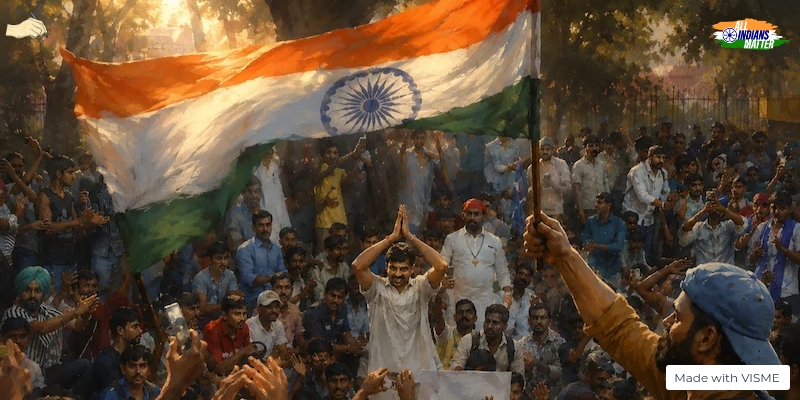
Usually, power shifts slowly. A generation tires, ages out or simply accepts that the future belongs to someone else, and it hands over the baton. What happened in India recently is not that. Watching the Cockroach Janta Party’s (CJP’s) sit-in at Jantar Mantar, and the spread of the movement across the country, culminating in Union Education Minister Dharmendra Pradhan’s resignation, the more important shift isn’t the handover itself but what changed hands. The power to set the agenda – to decide what gets discussed, on whose terms – has moved to a generation that stopped waiting for it.
Think of a relay race where the runner of one leg is slowing down. The next runner is looking for an exchange that isn’t coming soon, so they decide not to wait. They run to their partner behind and take the baton themselves. What matters, however, is what they do once it’s in their hand. In India’s case, what the youth have done is redraw the race entirely so that everyone else, government included, is now running to keep up with the terms they have set.
Consider what happened in terms of vocabulary. Chief Justice Surya Kant’s dismissive remark comparing unemployed youth to cockroaches was an insult. Abhijeet Dipke turned it into a name, the CJP, and within weeks the insult had been repurposed, worn as identity rather than felt as shame. The CJP’s own account of its founding describes it as beginning in May 2026 “as a political satire”, before hardening into a sustained sit-in over the NEET paper leak.
The establishment did not get to name this movement, frame its demands or set its tone. It had no choice but to respond inside a frame it never controlled. Even the Opposition, which normally leads protests of this scale, arrived late and adapted to a vocabulary it hadn’t authored.
That is a different kind of power than the power to force a resignation, and arguably a more durable one. The fight itself – its name, its refusal of manifestos and negotiated settlements in favour of memes and absurdist branding – was authored entirely by people young enough to have grown up not believing in the older grammar of Indian protest.
That agenda-setting power was tested when the state pushed back. When police used teargas and lathis to disperse the march to Parliament and tore down the camp, the protesters did not cede the high ground by rioting, nor did they retreat into the older, more familiar script of negotiated concession. They rebuilt the camp overnight and stayed on their own terms. As one 20-year-old protester, Sona Bisht, told NPR, “We are here talking about education, talking about securing our future.” Another protester, Sudhir Kumar, told CNN, “We will stand here with pride.” Neither statement asked permission to keep talking. That was an agenda holding under great pressure.
Last year, Gen Z rebelled in Nepal too. That comparison is instructive precisely because it shows how easily agenda-setting power can be lost even by a generation that wins its immediate demand. Nepal’s uprising last September also began as a youth-led challenge to an entrenched political class. But once the state met it with lethal force, at least 74 people died and more than 2,000 were injured. The story stopped being about what young Nepalis wanted and it became one of survival, buildings on fire and an interim government installed outside normal constitutional process. Prime Minister KP Sharma Oli’s resignation and Sushila Karki’s appointment were dictated by the emergency itself, not authored by the movement that started it. All this is not the same as a generation gaining authorship of the agenda.
India’s cockroaches forced a resignation and kept the pen. The conversation now under way about examination integrity, ministerial accountability and the credibility of institutions meant to certify a generation’s future is being conducted in terms this movement set, not terms handed down by the political class it confronted. That is a meaningfully different achievement than regime change, and it gets undersold whenever every instance of ‘Gen Z unrest’ in South Asia is treated as one interchangeable regional story.
None of this means that the underlying rot is fixed or that this movement has the organisational form to keep holding the pen indefinitely. A satirical party built for one sit-in is not built to run an institution. But the agenda has moved, and it has moved in a way that outlasts a resignation. For the first time in a long while, the terms of the conversation about accountability in India are being set by people who were, until very recently, considered too young and too unserious to be setting anything at all.
The relay runner didn’t wait for the handoff. They took the baton and decided where the race went next.