Ashraf Engineer
August 4, 2026
You’ve probably noticed it without quite articulating it. Vegetables are costly. Petrol hasn’t gotten cheaper. And yet, when the Reserve Bank of India (RBI) met on June 5, it didn’t raise interest rates to fight this. It held them steady at 5.25%, even as it quietly raised its inflation forecast for the coming year to 5.1% and cut its growth forecast to 6.6% from 6.9%. That’s not a technical detail but the RBI admitting that the two problems it usually fights separately – prices going north, growth going south – are now happening at the same time. Normally, you’d expect a rise in interest rates to fight inflation and a cut to stimulate growth. Instead, the RBI chose to not act on either, almost as if it’s on the horns of a dilemma. A cut in in rates could lead to higher inflation and a rise would suppress growth further.
The RBI’s decision to hold a “neutral” stance alongside the inflation and growth revisions sparked whispers of a stagflationary risk. One report flagged a sliding rupee, the oil shock making imports costlier and a possible monsoon shortfall as compounding the risk.
Stagflation is an economic condition defined by slow growth, high unemployment and rising prices, all at the same time.
Sit with that for a moment because most people don’t read it correctly. We’ve had a year of headlines about Iran, oil, the falling rupee… It’s easy to file all of it under ‘geopolitics’ but what happened on June 5 wasn’t that. It was the RBI showing it is no longer confident it can fix one problem without making the other worse.
What nobody’s talking about
Here’s what I find more revealing than the inflation print. Since the start of this calendar year, $13.7 billion has left India, most of it out of equities. It barely made it past the markets pages in the pink papers. But look at what the RBI did in response: it exempted foreign institutional investors and the Bank for International Settlements from capital gains tax. It removed investment limits on government securities. It opened a concessional forex swap facility to make it cheaper for public sector companies to borrow abroad.
That’s not routine housekeeping, but the RBI fighting an outflow with tools it doesn’t reach for unless it’s worried. When the RBI starts subsidising foreign capital to stay, it’s telling you something it isn’t saying out loud: the growth story investors have been buying into for two years is no longer selling itself.
A choice, not a default
Then came the part that should have made more noise than it did. In June, inflation crossed 4% for the first time since January 2025, breaching the RBI’s own target. By any conventional playbook, that’s when a central bank hikes rates. Governor Sanjay Malhotra called it “premature” to even discuss raising rates. In a poll of 72 economists, 68 expected the RBI to hold steady at its August meeting too, with rates likely on ice well into 2027.
The US Federal Reserve is running an almost identical calculation, just with more open disagreement about it. On July 29, it held rates steady for a fifth straight meeting – not a small thing, given inflation there has stayed above target for five years running. Three of its own regional presidents dissented, wanting to hike rather than hold. Chairman Kevin Warsh, pressed on whether this was simply a pause, pushed back, calling it “a rigorous review of the economic situation” instead. Strip away the different vocabulary and it’s the same instinct as Malhotra’s “premature”. That’s a central banker choosing a careful, uncommitted word because the honest line would be “we don’t know yet”. The difference is which way the market thinks each of them breaks. Investors expect the Fed’s next move to be a hike, not a cut. They expect the RBI’s to be neither for a while. Two central banks, the same energy shock, betting in opposite directions.
This is a deliberate bet by the RBI. It has looked at a fragile growth number, an economy still absorbing shocks like US tariffs and spiking oil prices, which it believes is temporary, and decided that defending growth matters more right now than defending the inflation target. It’s betting the shock passes before it has to spend its credibility proving it can control prices.
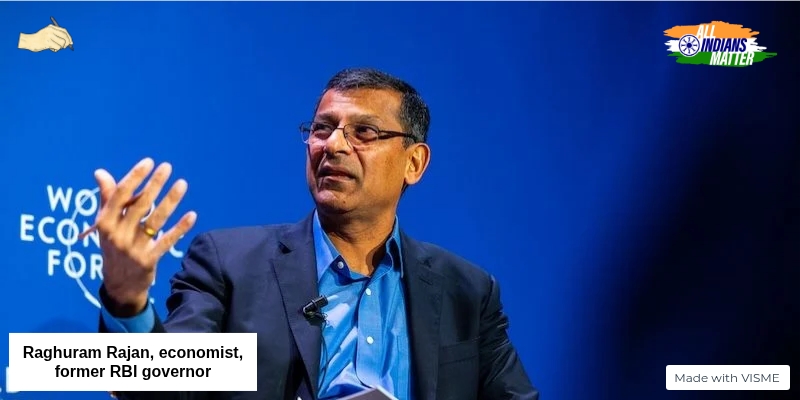
I’ve written before about what I call the credibility tax, the price an institution pays later for optimism it can’t fully back up now. Former RBI governor Raghuram Rajan made a version of this point himself recently, and it’s worth taking seriously precisely because he isn’t in office anymore and has no incentive to soften it. He asked why corporate investment and foreign capital inflows look so weak if the economy is genuinely expanding above 7%. His line, that something doesn’t add up when investment doesn’t follow growth this strong, is the same disconnect the RBI’s own revision quietly conceded.
This isn’t only India’s problem
Step back and India is a smaller, sharper version of a fight playing out everywhere right now. The International Monetary Fund (IMF) has revised global inflation up to 4.7% for 2026 from an earlier 3.8% estimate, almost entirely because of the same Middle East energy shock hitting India. Organisation for Economic Co-operation and Development (OECD) Secretary-General Mathias Cormann put it plainly: “The longer the disruptions last, the larger the economic and social costs become.” Every energy-importing economy on the planet is running some version of the RBI’s calculation: how much inflation can we tolerate before growth becomes the bigger casualty?
The difference is that most advanced economies have more room to absorb the shock. India doesn’t have that luxury. A weaker rupee makes every barrel of imported crude costlier in ways a stronger currency wouldn’t feel as acutely, and a growth story that depends partly on continued rate cuts has less to fall back on if the cutting stops.
What the bet is riding on
There’s a number worth watching more closely than any of this quarter’s GDP prints: $90 a barrel. That’s the threshold economists have flagged as the point where the RBI’s calculus flips, where “premature” to hike rates becomes “no longer optional”. From April through June, US crude oil futures averaged over $92 a barrel, a quarterly increase of 27%. On the regular market, it was trading at around $90 at the time of writing. The gap between where we are and where the RBI’s patience runs out is not large.
So, here’s the question I keep coming back to. India’s growth story for two years has leaned heavily on the promise of cheaper capital, more investment, more confidence. What happens to that story the moment the RBI runs out of room to cut, or worse, has to reverse course? The RBI is currently betting that question never has to be answered.