Ashraf Engineer
July 21, 2026
Not dead yet. Sonam Wangchuk kept saying something to that effect, even as his protest fast against the National Eligibility cum Entrance Test (NEET) paper leaks took its toll. Doctors said his body was breaking down; the government said that was why it needed to act. Wangchuk’s own message, in the days before the Delhi Police forcefully carried him away from Jantar Mantar to Safdarjung Hospital, was quieter and more stubborn than either version. He wasn’t going anywhere. He could sustain this a long while yet. Barely hours before he was whisked away, he had put out a message on X: “Smaller Movements have brought down many governments in India… & Here it is about education.”
The sit-in by the Cockroach Janta Party (CJP)and Wangchuk’s forcible removal have become the moment the country is arguing about. But the more important question sits underneath it, and it’s one I keep circling back to: can this sustain and can it lead to real change? That is genuinely open. What isn’t open, I think, is this: Indian democracy, which for a while now has been gasping for breath, just showed that it still has a pulse. Faint, but a pulse all the same.
From memes to Jantar Mantar
The CJP began as an insult that boomeranged. The Chief Justice’s throwaway remark about unemployed youth being like cockroaches birthed a satirical party with millions of followers and a register the establishment had no answer for: contempt met with contempt. What has changed since then is that the CJP has moved from Instagram to the street. Its founder, Abhijeet Dipke, has been sitting at Jantar Mantar demanding Union Education Minister Dharmendra Pradhan’s resignation over the paper leaks that upended the exam prospects of millions of students. Wangchuk, the Ladakh activist who has made an art form of the hunger strike as constitutional argument, joined him and, in doing so, gave the movement a gravity and a well-recognised face.
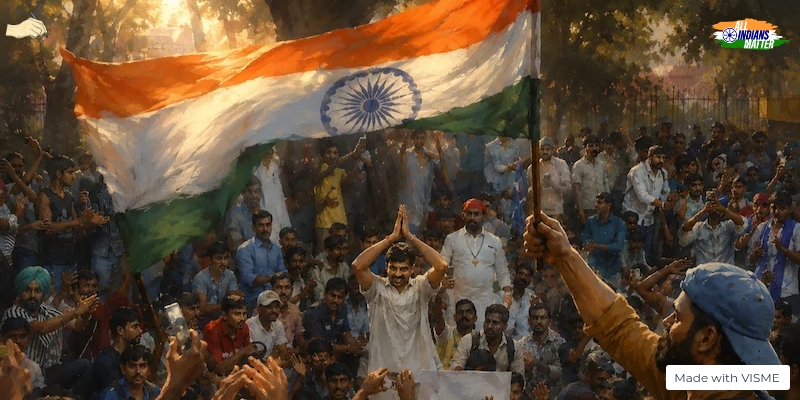
What followed had the shape of every genuine Indian protest I have witnessed in three decades of journalism: prohibitory orders, barricades, a government that refuses to engage and a ‘Sansad Chalo’ march that brought tens of thousands into central Delhi anyway. Police denied it permission. People came regardless. That, more than any number of Instagram followers, is the tell.
A predictable panic
The government’s response has been a rerun of a script we have seen several times before. When the CJP first emerged as a social media phenomenon, its X account was withheld in India and its website blocked, ostensibly on national security grounds. A satirical party of unemployed young people was, apparently, a threat to the state.
This time, the script moved from the digital to the physical. Rather than negotiate or even acknowledge the protestors, the government let the fast run for days, then had Wangchuk carried off, citing a Delhi High Court order and his deteriorating health. His wife has since gone back to the same court, alleging there was no medical emergency and that the hospital has been less than transparent about his condition.
Pradhan, for his part, has chosen to brazen it out. Opposition called the forced removal coercive and an affront to democratic norms. Dipke’s response tells you where this is headed: the CJP’s demand, which began as Pradhan’s resignation, has now escalated to a call for a change of the system. That is what happens when a government treats a protest as a law and order problem instead of a political one. It doesn’t make the protest go away; it makes the protest bigger.
A government secure in its record on jobs, on education, on young people’s trust, does not need to withhold a satirical party’s X handle or carry a 59-year-old man off a hunger strike site. That it did both is itself a kind of confession.
The people who show up
What I find genuinely moving, and what I think we should sit with rather than rush past, is who has been showing up at Jantar Mantar. Not political workers bussed in for a rally. Ordinary Indians turning up with a couple of bottles of water for the protestors. Someone else carrying food. Someone else with a container of milk for the students on hunger strike. Small, unglamourous acts of solidarity that no party organised and no hashtag campaign can manufacture.
We’ve seen this before. During the Citizenship Amendment Act (CAA)-National Register of Citizens (NRC) protests, it was the same instinct: people who had no stake in the argument beyond their conscience, quietly keeping others fed and hydrated so the sit-in could continue. It is, in its own modest way, democracy doing what democracy is supposed to do when its institutions won’t. Indeed, the courts have failed us. The media have failed us. And the government is diabolical.
The sit-in also reminds me, inevitably, of Shaheen Bagh. That was a real awakening, women holding a protest site for months through a Delhi winter, forcing a national conversation about citizenship and belonging that the government would rather not have had. And then COVID-19 arrived and shut it down before we ever found out what it might have become.
I think about that often. The CJP-Wangchuk moment carries the same risk: momentum this genuine can be interrupted by forces that have nothing to do with its merits.
A history of protests
None of this is unprecedented and that history is worth naming because each of these protests has this same quality: real anger, real sacrifice and an uncertain relationship with lasting change.
There was the anger after Dalit scholar Rohith Vemula’s suicide in 2016, which briefly forced India to look directly at caste discrimination in its universities before the news cycle moved on. There was the farmers’ agitation, sustained for over a year, that eventually forced the repeal of three farm laws, one of the few recent instances where street pressure alone reversed government policy. And there was the Bharat Jodo Yatra, Congress leader Rahul Gandhi’s long walk across the country, which did not by itself return the Congress to power but did enough to hand the Bharatiya Janata Party (BJP) its most serious electoral setback in a decade.
The government’s response has been telling: rather than course-correct, it has worked to fracture opposition parties from within, including those of its own allies. This is not a government that feels secure.
The heart still beats
Indian democracy is not for beginners and neither is saving it. I am genuinely unsure whether it can be done at this point, whether a system this large, this compromised, this exhausted, can be nursed back to health by hunger strikes, hashtags and bottles of water handed to strangers. But I keep coming back to the alternative, which is not trying. I find I cannot sit with that either.
Whether the CJP and Wangchuk’s protest turns into something larger or whether it goes the way of Shaheen Bagh is not something I can predict. What I can say is that this is now a pattern too consistent to dismiss: Rohith Vemula, Shaheen Bagh, the farm laws, Bharat Jodo and now Jantar Mantar. Each one arrives, is met with the same instinct to suppress rather than engage and each one leaves behind a residue that the next protest inherits.
Indian democracy has looked, for a while, like it was gasping for breath. It is still gasping. But watch closely and you can see the pulse. Faint, uneven, but there.