Ashraf Engineer
August 19, 2026
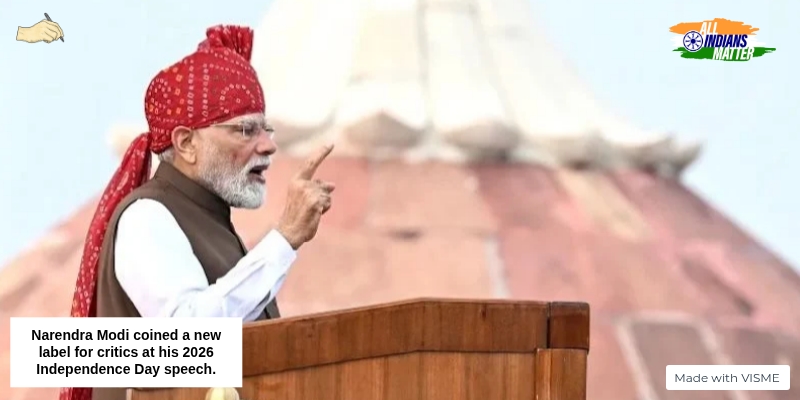
On Independence Day, from the ramparts of the Red Fort, Prime Minister Narendra Modi reached for a phrase that hadn’t existed in the political lexicon earlier: “Dimagi Naxal.” A Naxal of the mind. Not someone who has picked up a gun in the forests of Chhattisgarh, but someone who has picked up an idea in a seminar room, a college debate or by thinking about what is happening in the country. Former finance minister P Chidambaram replied within a day, saying he was proud to be a Dimagi Naxal.
Within hours, an Instagram account calling itself the Dimagi Naxal Party had crossed 1.8 lakh followers. It’s motto: Think, Research, Resist. Saurav Das of the Cockroach Janta Party (CJP) asked, reasonably, how an educated young person could be labelled a Naxal for simply questioning the government. Bharatiya Janata Party (BJP) spokesperson Sudhanshu Trivedi countered that anyone lending support to what the party considers an anti-national ideology qualifies. He was careful to note it was a political claim, not a legal one.
The tendency to label opponents isn’t new; in fact, it’s a pattern.
Let’s line up the last decade of the BJP’s vocabulary for its opponents. ‘Urban Naxal’ arrived first, sometime around 2017, borrowed from filmmaker Vivek Agnihotri’s framing of unarmed sympathisers embedded in universities, courtrooms and newsrooms. ‘Tukde Tukde Gang’ followed out of the 2016 Jawaharlal Nehru University sedition controversy, an accusation that some students wanted the country broken into pieces. ‘Khan Market Gang’ came in 2019, when Modi, fresh off a landslide, said that his image hadn’t been built by the Delhi upper-crust market’s English-speaking regulars or “Lutyen’s Delhi” but by his own toil. Now, we have ‘Dimagi Naxal’, fusing the insurgent-sympathiser framing of the first with the intellectual-class framing of the third.
Four labels in under a decade; that’s more than rhetorical creativity.
Every one of these terms performs the same quiet act of collapse, folding “disagrees with the government” into “internal security threat”. That is the load-bearing pillar that holds up Urban Naxal, Tukde Tukde Gang, Khan Market Gang and Dimagi Naxal alike. The specific accusation changes (separatism, elitism, insurgent sympathy) but the underlying function doesn’t. Disagreement gets reclassified as disloyalty, and disloyalty gets to borrow the weight of an actual, historically bloody insurgency that has killed security personnel and civilians for over five decades. That is the whole point. It’s far easier to dismiss a “Naxal” than to engage a critic.
This is precisely the criticism that keeps recurring from the other side of the aisle, expressed almost identically each time a new term lands. It’s what Chidambaram was doing and it’s what Das was doing when he asked how a student loses their freedom by questioning policy. It’s what journalist Swati Chaturvedi captured when she described the whole vocabulary as pejoratives met mostly with mockery rather than fear, precisely because everyone recognises the move being made.
What is more revealing than the insults is what happens when you ask the state, formally, whether it stands behind them. In response to Right To Information queries, the Ministry of Home Affairs has said on record that it has no information concerning either ‘Urban Naxal’ or ‘Tukde Tukde Gang’ as phrases it recognises, even as Modi and Home Minister Amit Shah have used such terms from public platforms. That gap is the story. A term can be weaponised from the Red Fort and simultaneously disowned by the ministry that would have to act on it if it meant anything legally. It exists purely in the rhetorical register, engineered for political work without ever being pinned down enough to be falsified, litigated or held accountable. It is, as a columnist put it, everyone and no one, a shapeshifting enemy that expands to fit whoever has a problem with the state.
That elasticity is precisely why the vocabulary keeps needing replacing. A label that means everything eventually means nothing; it gets absorbed, mocked, reclaimed and its sting dulls. ‘Khan Market Gang’ became a badge of pride for the very columnists it targeted. ‘Urban Naxal’ became a punchline. ‘Tukde Tukde Gang’ even got its own merchandise. And now ‘Dimagi Naxal’ has been claimed by a former Union minister and turned into a satirical Instagram identity within 24 hours. It’s a reclamation cycle that used to take years but is now taking a single news cycle, because social media metabolises stigma faster than propaganda could counter earlier.
This is the deeper pattern I keep returning to: a centre that cannot hold doesn’t announce itself with collapse. It announces itself with an accelerating need for enemies precise enough to rally the base but vague enough to never require proof. Four derogatory terms in a decade isn’t strength. It’s the sound of a political vocabulary running out of runway, needing a new coat of paint each time the old one gets scraped off by the very people it was aimed at.
The next term is already being drafted somewhere. Give it a few months.