Ashraf Engineer
April 21, 2026
“You performed a miracle today. Hungary made history today.”
Amid chants of “Ria-Ria-Hungaria!”, Péter Magyar chose accuracy over modesty on the night of April 12 as thousands gathered along the banks of the Danube in Budapest. Sixteen years after he came to power, a once-invincible Viktor Orbán, sometimes seen as the global godfather of illiberal democracy, was swept out of power. His challenger won over 53% of the vote, with Orbán’s Fidesz party reduced to a “painful” 37%. The turnout of 79% was a verdict in itself. For those watching from India, where the Bharatiya Janata Party (BJP) lost its outright majority two years ago in a result that defied every exit poll, the resonance was hard to miss.
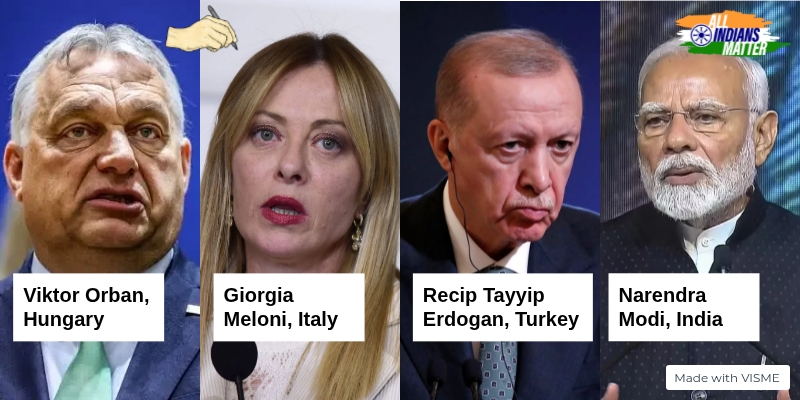
It’s worth asking the hard question: is Hungary the beginning of something or merely an exception? Is this the first in a series of dominos, a sign that other right-wing governments, such as those in India, Italy and Turkey may face similar verdicts?
The economics of disillusionment
To understand what happened in Hungary, look at the numbers. Since mid-2022, the economy has been stuck in a no-growth zone. The Organisation for Economic Cooperation and Development projected GDP growth of just 0.3% for 2025 and Hungary faced the highest inflation in the European Union (EU) in 2023, averaging 17.1%. Meanwhile, wages in education and healthcare remained among the lowest in the EU, while oligarchs close to Orbán grew conspicuously richer. Many in India would resonate with this, especially with how much wealthier the super-rich got during the COVID-19 pandemic.
Transparency International, meanwhile, ranked Hungary the most corrupt country in the EU, a ‘distinction’ it held for 13 consecutive years.
This is the central irony of right-wing populism everywhere; it campaigns on the anxieties of ordinary people but, when in power, tends to serve the extraordinary few. Rather than grappling with an economy that had fallen apart, Orbán pointed to “marauding outside forces… who supposedly pose threats to Hungarians and Hungarian-ness,” as David Pressman, former US ambassador to Hungary, told CNN. “It is much easier for the leader of the country ranked the most corrupt in the European Union to talk about civilisational struggles” than to explain why your family’s wealth has grown while your people’s has not, he added.
Magyar was a former Orbán loyalist but he broke away after a child abuse scandal. He then campaigned on corruption, healthcare and public transport – the unglamorous essentials of daily life – much like Zohran Mamdani did in the New York mayoral campaign.
Pattern or one-off?
Many would see Hungary’s as the first among right-wing governments across the world that could meet the same electoral fate. While hope must float, they would be wise to not celebrate yet. In October 2023, Poland’s Law and Justice Party (PiS), another illiberal government, was voted out after eight years in power. But Poland proved to be a warning against over-optimism. Within two years, a PiS-backed candidate narrowly won the Polish presidential election. In the 2024 European Parliament elections, PiS and the far-right Confederation together won nearly 50% of the Polish vote. The lesson from Poland is not that populism is dead but that it is elastic.
Now, let’s look at Italy and Turkey – two countries Indians don’t often think about in the same breath as their own politics, but should.
Italy’s Giorgia Meloni, the far-right leader who came to power in 2022, remains standing. Her party still polls around 30% but the cracks are visible. At the end of last year, 51% of Italians disapproved of her government. In March this year, voters rejected her flagship justice reform in a referendum, with the opposition winning around 54% of the vote. It was a significant blow ahead of the general elections due in 2027.
Italy, like Hungary, bet on cultural nationalism while struggling to translate political stability into economic growth.
In Turkey, the picture is even starker. As recently as April 2026, only 11.8% of Turks believed the economy was being well managed, while 83.4% said it was poorly managed. This was an astonishing number that cut across party lines, including two-thirds of President Recep Tayyip Erdogan’s own AKP voters. The opposition CHP did better than the AKP in local polls last year and 67% of Turks said in July 2025 that they wanted the Erdogan era to end.
Erdogan responded to the growing resentment by having Istanbul’s Mayor Ekrem Imamoglu, his most credible challenger, arrested on charges widely seen as politically motivated. This sparked mass protests across Turkey.
When a government imprisons the opposition, it is not demonstrating strength but fear.
What about India?
The 2024 election delivered a verdict that the BJP’s strategists had not expected. The party won 240 seats, down sharply from the 303 it held in 2019 and well short of the 272 needed for a majority. For the first time in a decade, Prime Minister Narendra Modi needed to depend on coalition partners. The opposition INDIA alliance, written off by virtually every exit poll, won 230-odd seats. It was a performance that returned the Congress to the status of a genuine opposition for the first time in a decade.
What drove those numbers? Much the same forces at work in Hungary: economic anxiety, unemployment, the sense that growth numbers do not reflect the lived reality. The BJP had campaigned on “400 paar” and the electorate’s response was a polite but firm no.
Here’s where the comparison requires caution. Unlike Hungary, the Indian opposition has not yet coalesced around a single challenger with a compelling narrative. INDIA remains an alliance of convenience, held together (barely) more by what it opposes than what it stands for. The factors that might fuel a reckoning include youth unemployment, rural distress, a middle class that feels embattled even as GDP numbers look respectable.
But conditions and outcomes are not the same thing. Hungary had grievance and alternative. India has the grievance but the alternative remains a work in progress.
The long arc
None of this is to say that right-wing nationalism is on its last legs. It remains formidable in much of Europe and has deep roots in countries like Turkey and India. The anxieties that fuelled it – economic insecurity, cultural displacement – have not retreated. But what Hungary tells us, what Poland hinted at, is that the authoritarian bargain eventually exhausts itself. When a government promises order and delivers stagnation, promises sovereignty and delivers oligarchy, promises national pride and delivers embarrassment, even its most loyal voters begin to look elsewhere. The question is whether the opposition is ready when that moment arrives.
Change, when it comes, rarely announces itself dramatically. It arrives as it did along the Danube on a Sunday night, in the form of a quiet majority that finally decided it had had enough. Whether that majority is forming in Turkey, Italy or here at home is a question only the next election will answer.