Ashraf Engineer
May 11, 2026
Did you know that India, a water-stressed nation, is a major export of ‘virtual water’?
So, what is ‘virtual water’ and how exactly do you export it? Virtual water is among the most consequential ideas in environmental policy and has a direct impact on India’s future. Let’s try to understand what it means and why you should be paying attention.
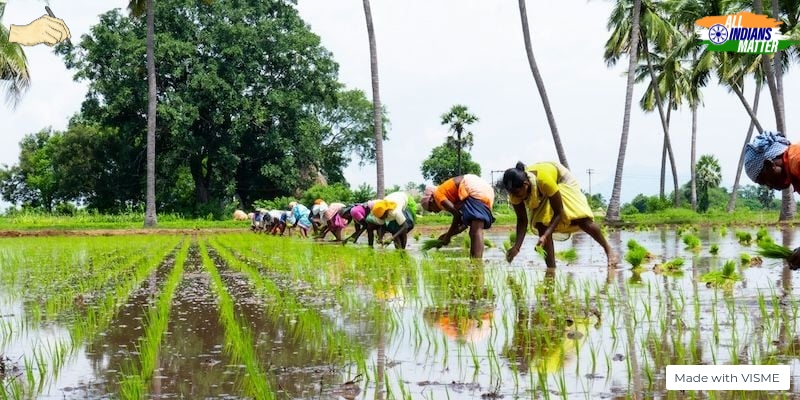
When rice grown by a farmer in Punjab is sold abroad, what exactly is being exported? Rice, obviously, but embedded in every kilogram of it is the water it took to produce it. That water, from underground aquifers that took thousands of years to fill, is now gone. It has left Indian shores in a bag of grain. Virtual water is this hidden volume of water flowing out of a country’s borders disguised as food. In India’s case, the numbers are staggering.
And ICRIER study in 2018 said virtual water is exported through “water-guzzler” crops like rice and sugarcane, often grown in water-stressed regions like Punjab and Maharashtra. The study suggested a need to align cropping patterns with regional water availability to improve sustainability, productivity and profitability. The study said more than 60% of of India’s irrigation water was consumed by rice and sugarcane, highlighting a need for improved efficiency, especially as water resources shrink.
World’s rice bowl running dry
India has emerged as the world’s largest rice exporter of rice, accounting for nearly 40% of the global trade. That is a remarkable achievement – the country has 1.4 billion mouths to feed and still has enough left to sell to the world.
Rice, however, is one of the thirstiest crops on earth. Growing a single kilogram of paddy requires roughly 15,000 litres of water, as documented by researchers at Anna University, Chennai, in a study published in the journal ‘Groundwater for Sustainable Development’ in 2019. India exports more than 21 million tons of rice annually. Do the math and you begin to understand the scale of what is shipping out of the country.
Between 2006 and 2016, India exported 26,000 million litres of virtual water every year, according to the Anna University study. Rice led the way, followed by buffalo meat, for which the virtual water footprint is five to 20 times higher per kilogram than for crops, and maize. In those 10 years, India exported nearly 497 trillion litres of virtual water while importing only 238 trillion litres, making it a massive net exporter of an invisible, irreplaceable resource.
The more recent figures are even more alarming. According to one analysis, the estimated virtual water export from rice alone in 2023-24 stood at 40.87 billion cubic metres. To put that in perspective: that could meet nearly 17% of India’s entire annual groundwater extraction for all uses, or about 20% of what agriculture alone draws in a year.
This is structural, policy-enabled haemorrhage at a time when India is categorised as ‘water insecure’ (Global Water Security 2023 Assessment) and an ‘extremely high water stress’ country (WRI Aqueduct Water Risk Atlas).
The aquifer problem
Here is where it gets worse. India is not exporting rainwater or river water. It is exporting groundwater, the kind that sits deep in aquifers and replenishes over geological timescales, not human ones.
Consider the numbers. As per a 2022 assessment, India’s annual extractable groundwater resource is 398 billion cubic metres. It extracts 239 billion cubic metres every year across all uses. Of that, 208 billion cubic metres (87%) goes to agriculture. India is essentially mining its underground water the way one mines coal. Except that, unlike coal, we actually need water to survive.
The geography of this crisis is specific. Punjab and Haryana, India’s grain bowl, are among the worst affected. In parts of these states, the water table is dropping by more than a metre every year. An IWA Publishing study on the virtual water trade in India, published in the journal ‘Water Supply’, found that several regions have already entered the ‘red zone’. This means extraction has far outpaced replenishment and water scarcity is structurally embedded. The study, drawing on data showing that rice production alone accounts for about 16% of India’s total available water, is unambiguous: this trajectory threatens not just water sustainability but food sustainability.
Why is this happening?
A combination of incentives and subsidies has built this trap, and unpicking it requires understanding how each piece fits together.
Electricity is the first. Farmers in Punjab, Haryana and several other states receive free or heavily subsidised power for irrigation. This removes costs that might encourage water conservation. If pumping groundwater costs nothing, you pump as much as you need and often more.
The second piece is the minimum support price (MSP) for rice. By guaranteeing a floor price, MSP makes paddy cultivation attractive even in regions where the climate and water table make it ecologically inappropriate. Punjab is not a naturally rice-growing state; its traditional crops were wheat and coarser grains. The Green Revolution changed that and MSP locked it in.
The third piece is the export earnings themselves. Rice brings in valuable foreign exchange. In 2024-25, India’s agricultural exports clocked $51.2 billion. It’s a number governments find very difficult to argue against, even when the cost being paid is groundwater that will not return in our lifetimes.
What this means for you
For the common Indian, this crisis arrives on several fronts simultaneously.
The most immediate is water availability. If aquifers in Punjab and Haryana collapse, the consequences go well beyond those states. Punjab’s farms feed much of India. A water crisis there is a food price crisis everywhere. Families in Mumbai, Chennai, Kolkata and Bengaluru will feel it in the cost of wheat flour, rice and vegetables. The poor, who spend a disproportionate share of their income on food, will feel it most acutely.
Then there is the question of drinking water. India already has acute urban and rural water stress. Diverting groundwater at scale to grow export crops tightens the supply available for domestic consumption, sanitation and industry. Over-extraction of groundwater for irrigation has already created water scarcity in many parts of India; climate change will make that worse.
For farmers themselves, the picture is particularly difficult. The very crops they are incentivised to grow are destroying the resource they depend on. When the groundwater runs out, the options are expensive borewells that go deeper and deeper, or crop failure. Either way, rural distress deepens. The irony is that the policies meant to help farmers are, in the long run, making their futures more fragile.
What needs to change
To be clear, agricultural exports have benefited the economy greatly and you can’t simply stop them. They are a critical component of economic growth and have immensely improved farmers’ lives. What’s needed instead are structural solutions across various sectors and services. These solutions are known, although they are not easy.
The first and most debated reform is restructuring electricity subsidies for agriculture. If farmers pay even a modest cost for pumping groundwater, they have a reason to be more careful with it. The political difficulty is real – free power is a promise with deep electoral roots. But states like Gujarat have shown that metered and time-of-day power supply for agriculture can reduce groundwater extraction without devastating farmers, provided it is paired with income support.
The second reform is rethinking MSP and crop diversification. India needs to incentivise water-efficient crops (pulses, millets, oilseeds) as aggressively as it has incentivised rice and wheat. Interestingly, the crops India imports have a significantly lower virtual water content than what it exports. As the Anna University researchers noted, cashews, pulses and wheat – imports with the highest virtual water content – use far less water than rice. We are trading high-water-cost exports for lower-water-cost imports. The policy logic should follow that reality.
The third is integrating virtual water accounting into trade policy. This is perhaps the most sophisticated change, and the one least discussed. A country’s trade policy cannot be divorced from its resource balance sheet. If India is exporting a resource at rates that compromise its long-term viability, that should feature explicitly in how export incentives are structured and which commodities are prioritised.
Finally, water governance must move from the states to a coordinated national framework, particularly for shared aquifers that cross state boundaries. Groundwater does not respect such borders and piecemeal state-level policies have been inadequate for the scale of the problem.
***
India is often described as a civilisational story, a country that has persisted through millennia because it found ways to manage its land and water wisely. The construction of stepwells, the design of ancient irrigation systems, the community protocols around water use, these were not accidents. They were adaptations built by people who understood that water is the foundation of everything else.
The virtual water crisis is, in a sense, a modern civilisational test. The numbers may be abstract but what they describe is concrete: India is drawing down the water reserves that future generations will need to drink, cook, bathe and farm. And it is doing so, in significant part, to export rice at prices that do not reflect the true cost of what is being depleted.
That is not a trade but a slow liquidation. The time to reckon with it is now, while there is still something left to save.